
DeMar and Gregory Wilson Mantilla, UW professor of biology and curator of vertebrate paleontology at the Burke Museum, co-authored a paper that sheds light on why birds are the only group of dinosaurs that survived the mass extinction 66 million years ago. The paper was published in Current Biology in September 2026.
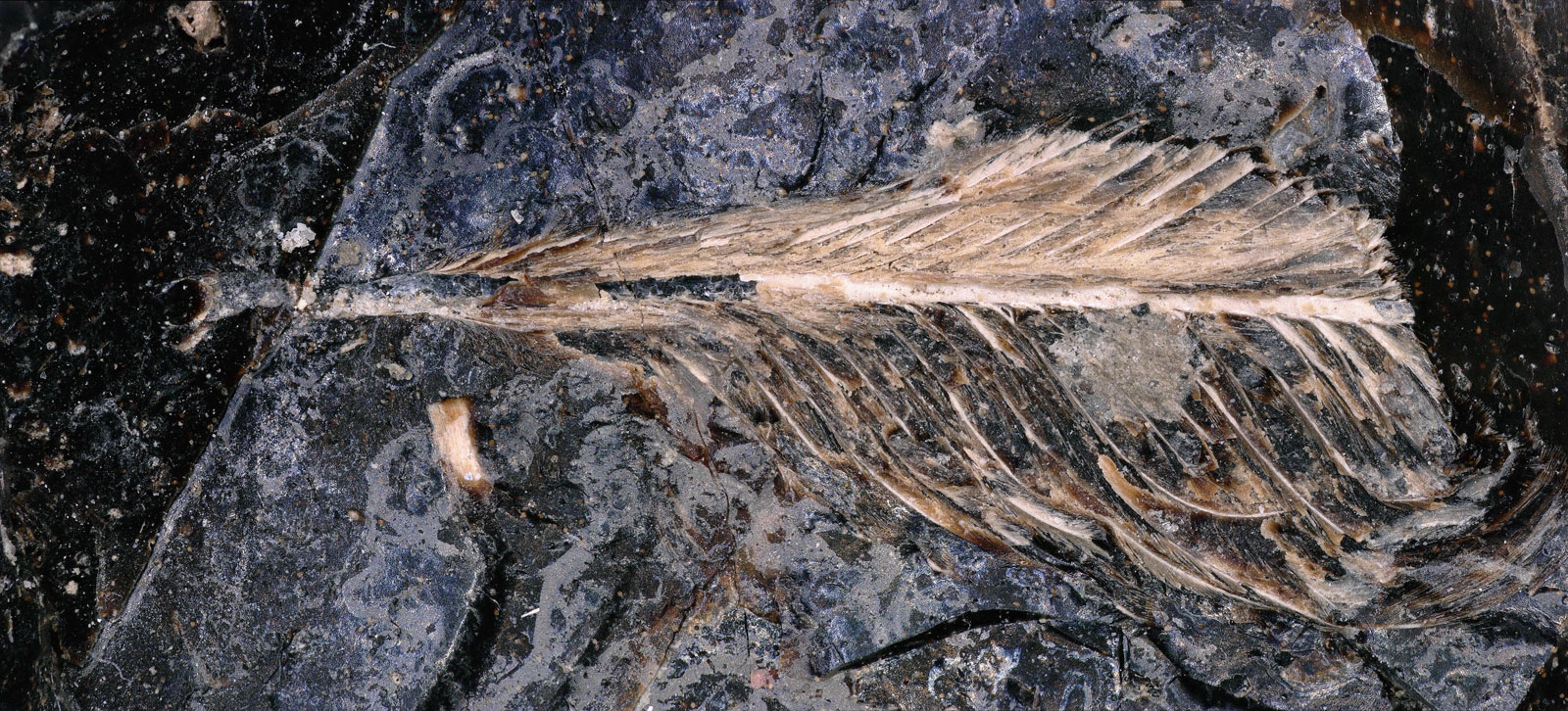
“We rarely find fossils of birds and even more rarely their feathers, giving us such important insight into the evolution of this key aspect of their biology. On top of that, these bird feathers found within a large, fossilized dinosaur dung gave us an incredible window into predator-prey interactions 66 million years ago." said co-author Gregory Wilson Mantilla, UW professor of biology and the curator of vertebrate paleontology at the Burke Museum.
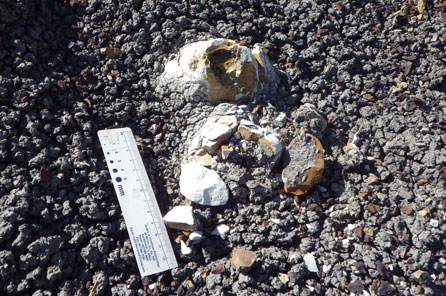
A portion of a theropod dinosaur coprolite (fossilized feces) eroding out of the Hell Creek Formation in northeastern, Montana.
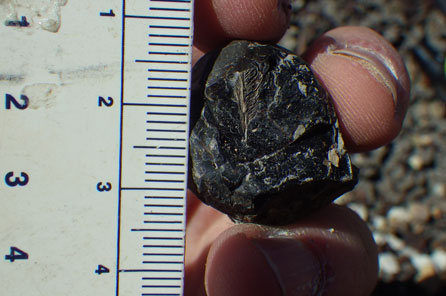
A fragment of a theropod dinosaur coprolite with a bird feather on its surface.
We rarely find fossils of birds and even more rarely their feathers, giving us such important insight into the evolution of this key aspect of their biology.
Gregory Wilson Mantilla, Curator of Vertebrate Paleontology, Burke Museum
Recently, DeMar and Wilson Mantilla, along with their coauthors and lead author Jingmai O’Connor, associate curator of fossil reptiles at the Field Museum, analyzed the specimen’s mineral composition and examined CT scans, finding multiple feathers, fish scales and leg bones from an extinct group of diving birds called hesperornithiforms.
“We think the types of feathers that these birds had, and/or the way they molted those feathers, may have been one of the underlying causes of the selectivity of the end-Cretaceous mass extinction — essentially, why some birds died out and why others survived,” said O’Connor.
Read the publication in Current Biology
Read the article in UW Today
Elliott Armour Smith, UW doctoral student in biology; Michael Holland, the Hell Creek Project Fossil Preparator at the Burke Museum of Natural History; Karen Chin at the University of Colorado, Boulder; Alexander Clark at the Field Museum and the University of Chicago; Christian Cooper at the Field Museum; Pei-Chen Kuo at the Institute of Vertebrate Paleontology and Paleoanthropology, Chinese Academy of Sciences; Thomas Tobin at the University of Alabama; Aaron Celestian at the Natural History Museum of Los Angeles County; David Bottjer at the University of Southern California; and Luis Chiappe at the Natural History Museum of Los Angeles County are also co-authors on this paper. This research was funded by donations to the Hell Creek Project.
For more information, contact Wilson Mantilla at gpwilson@uw.edu and DeMar at ddemar@uw.edu.