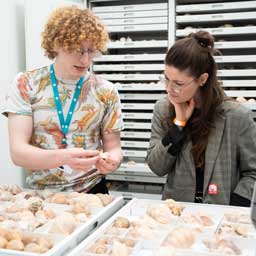





A study by Deanna Flores, a Ph.D. candidate at the University of Oregon, sheds light on the underdocumented record of small mammals in western North America. Small mammals, especially rodents, are good indicators of local environmental conditions due to their rapid evolutionary responses to climate change. By establishing a baseline of diversity prior to extensive tectonic activities, her research offers valuable insights into past ecosystems and provides perspectives on current environmental challenges and conservation efforts. Flores is set to graduate in June and plans to focus on teaching, aiming to make science more accessible to the public. We asked Deanna a couple of questions about her research.
Why is this research important?
My research is important because it addresses the underpublished record of small mammals in western North America. Small mammals, particularly rodents, are great indicators of local environments. Rodents had an all-time high diversity during the Oligocene and very early in the Miocene, but their diversity plummeted throughout the Miocene. Looking through the Oligocene, most of our data comes from the Great Plains/East Coast. In western North America, only 41 published small-mammal sites exist to date. Comparing the two sides of North America, the Great Plains and the East Coast have a higher number of species during the Oligocene, which is not what a lot of scientists expected to see. Our modern fauna shows a higher number of species in western North America. My research hopes to figure out if we are dealing with a sampling issue or if we are seeing a true representation of diversity during the Oligocene.
What will this research contribute to the field?
My research will contribute to a more thorough understanding of how environmental changes, particularly toward colder and drier climates, influence small-mammal diversity west of the Rocky Mountains. My research will help to form a baseline understanding of diversity before the extensive tectonic activity ( e.g.,Basin and Range extension) occurred in western North America.