
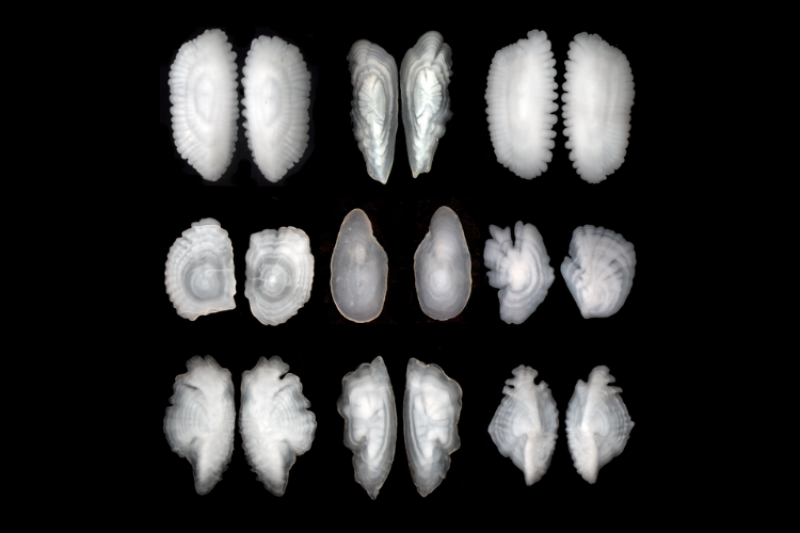
Otolith pairs (two per individual fish) from an assortment of Bering Sea fish species. Top row (left to right): walleye pollock, sablefish, Pacific cod. Middle row: Alaska plaice, Dover sole, Greenland turbot. Bottom row: Pacific ocean perch, Atka mackerel, shortraker rockfish. Walleye pollock and Pacific cod are among the species analyzed with near-infrared spectroscopy. Note: otolith sizes are not on a relative scale. Credit: NOAA Fisheries
Much like counting tree rings, scientists study fish ear stones — known as otoliths — to measure age and growth rates. These small, hard calcium carbonate structures sit in a fluid-filled pocket behind the fish’s brain, helping it balance and hear.
Beyond revealing age, otoliths act as natural recording devices. As a fish grows, its ear stones absorb trace elements from its diet and the surrounding water.
Every year at sea, fisheries observers and scientists aboard research surveys collect about 45,000 of these specimens. Over four decades, these routine surveys built an enormous archive of 2.5 million otolith pairs dating back to the 1960s. Today, they are housed at the University of Washington’s Fish Collection, a shared facility between the Burke Museum of Natural History and Culture and the School of Aquatic and Fishery Sciences.
Read the feature article to learn more about these “time capsules” and the incredible partnership between the Burke Museum and NOAA Fisheries.