


Event Partners
Support for the invited speakers was provided in part by the Quaternary Research Center.
This program is generously supported by the City of Seattle Office of Arts & Culture.

Tuesday, May 12, 2026
6 p.m. doors open,
6:30 p.m. program begins
This event is in the past.
FREE admission for all;
Registration required
This panel discussion features George Swanaset Jr., Dr. Clarita Lefthand-Begay, and Dr. Ora Marek-Martinez.
Told through a story of Indigenous survival, this discussion focuses on the challenges and potential solutions offered through a novel approach to research with and by Indigenous Peoples — braiding knowledges.
Indigenous Peoples across the globe are facing extreme challenges due to climate change at increasingly rapid rates, ranging from destruction of homelands to the theft of resources, such as water and power to cool data centers. The lack of support and resources from federal, state, and local partners exacerbates the solutions afforded to Native and Indigenous Nations and communities, who are often left to face these issues alone.
The impact of settler-colonial policies restricts the reliance on cultural and traditional ways of stewarding homelands that Native and Indigenous Nations and Communities have relied on since time immemorial. Braiding knowledges offers a potential solution that incorporates both Indigenous Knowledges and western knowledges to address issues in ways that honor longstanding relationships and that recognize the utility of transdisciplinary braided approaches, creating a third co-creative space for research and work with and by Native and Indigenous Native and Communities.
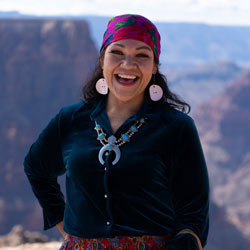
Dr. Ora Marek-Martinez is a citizen of the Navajo Nation and a descendant of both the Nez Perce tribe and the Hopi tribe, originally from Lapwai, Idaho. Dr. Marek-Martinez is an Associate Professor in the Anthropology department at Northern Arizona Unviersity in Flagstaff, Arizona. Dr. Marek-Martinez started her career as an archaeologist for the Navajo Nation Archaeology Department in 1999 and continued her work throughout her educational journey. She started at the Navajo Nation in 2008 as a Supervisory archaeologist while she conducted her dissertation research on articulating a Diné (Navajo) archaeology with, by, and for the Navajo People. Before she left the Navajo Nation, Dr. Marek-Martinez served as the Navajo Nation’s Tribal Historic Preservation Officer. Starting in 2016, she returned to Northern Arizona University as an Assistant Professor in the Anthropology Department, her research interests include Indigenous archaeology and Indigenous Heritage management, including research and approaches that utilize ancestral or cultural knowledge in the creation of archaeological knowledge.
Dr. Marek-Martinez’s other research interests include southwestern archaeology, Indigenous futurisms, and decolonizing and Indigenizing archaeological narratives of the cultural landscape on Indigenous homelands as a way to reaffirm Indigenous connections to land and place. Her current research focuses on an NSF awarded STC entitled “Center for Braiding Indigenous Knowledge in Science”. NAU will be the CBIKS’ Southwest Hub researching with Indigenous Communities, NAU Faculty and Students in the areas of climate change, protection of heritage places, and food sovereignty. This work personifies her goal to contribute to the efforts in our discipline to move archaeology beyond its colonial origin. Dr. Marek-Martinez is also a founding member of the Indigenous Archaeology Coalition and was recently a consultant and featured in episode one on Streaming Curiosity’s documentary series “The Real Wild West”.
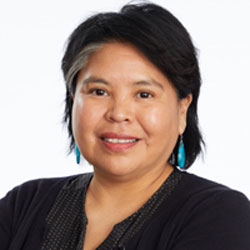 Dr. Clarita Lefthand-Begay (she/her) is a citizen of the Navajo Nation and an Associate Professor at the University of Washington’s Information School (iSchool). Her work advances Indigenous Knowledge Systems through community-engaged research and mentorship that center American Indian and Alaska Native experiences. Situated within the fields of environmental health, critical Indigenous studies, and information science, Dr. Lefthand-Begay investigates Tribal water security, research ethics, research methods, Indigenous data justice, and the ethical integration of Indigenous knowledges in decision-making. Her research extends through interdisciplinary partnerships with Tribal nations in Alaska, the Pacific Northwest, and North America. Through these collaborations, she builds trust-based relationships that honor cultural protocols and Tribal priorities, with the goals of strengthening sovereign data and environmental capacities, promoting health equity, and deepening the relationships between the iSchool and Tribal communities.
Dr. Lefthand-Begay was an author for the U.S. Global Change Research Program’s Fifth National Climate Assessment. Her research has been funded by the U.S. National Science Foundation, U.S. Environmental Protection Agency, USDA Forest Service, and Robert Wood Johnson. Under a center grant from the U.S. National Science Foundation, she provides co-leadership for the Pacific Northwest Hub’s Center for Braiding Indigenous Knowledges and Science (CBIKS). CBIKS unites the global Indigenous community and scholars from several universities to effectively and ethically braid together Indigenous and Western science research. Recently, she served as Deputy Director and Director of Relations with Tribal Nations, Communities, and Organizations for UW’s Center for Environmental Health Equity. Lefthand-Begay received her Ph.D. in Environmental and Occupational Health Sciences from the University of Washington’s School of Public Health and her B.S. in Biology from the University of Arizona.
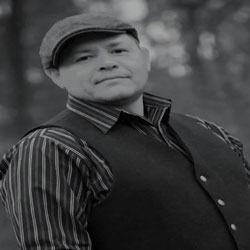 George Swanaset Jr. “Yelqaynem," is a Coast Salish artist of the Nooksack Tribe who has learned from his father, George Swanaset Sr., to carry on the traditional practices handed down through many generations. As Director of the Cultural Resource Department for the Nooksack, preserving cultural/traditional ways is of paramount concern.
George Jr. started carving at a young age, watching his father, and other carvers work on many different projects ranging from small masks to large canoes, learning that each item that had been created served its own purpose in in the everyday life of the Nooksack people. Though the Nooksack Tribe was not historically known for art work as we understand it today, George has learned that the way the Nooksacks have lived was indeed a form of art in itself. From constructing fishing traps, making the stone hammers and stone adze, to carving the dugout canoes, and building the long houses, each item serves its own purpose.
Today, George works with other tribal members to restore the stories, traditions, and life skills of the Nooksack people, so that they understand culture is not a past tense, but is alive today, and that the Nooksack people possess the very art of living.
George not only works with history and culture, but also works as the director of the Nooksack cultural resources. The natural resources of the Nooksack are also believed to be the cultural resources. Without one, the other would not exist.
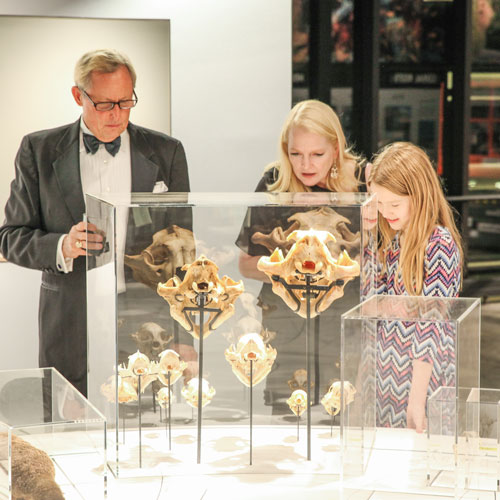
Host your one-of-a-kind gathering at the Burke Museum and give your guests an experience they'll never forget.
Continue to general admission tickets page.