


Event Partners


Event Sponsor

Wednesday, May 6, 2026
6:30 p.m.
This event is in the past.
How do science writers and illustrators collect the data, information, and stories that inform their art? Join three Pacific Northwest artists — two writers and one illustrator — to learn how they distill their research on our local seabirds into engaging stories and compelling illustrations. You’ll hear stories from Madison Mayfield, a science illustrator, taxidermist, and Assistant Collections Manager of the Burke Museum’s ornithology collection. You’ll find out how author and community scientist, Maria Mudd Ruth, turned data — and a lack of data— into her new book on the Pigeon Guillemot, The Bird with Flaming Red Feet. Eric Wagner, author and professional scientist, will share secrets for collecting and interpreting data on nocturnal Rhinoceros Auklets for his new book, Seabirds as Sentinels.
Join Maria Mudd Ruth, Eric Wagner, and Madison Mayfield for a succinct illustrated presentation followed by lively conversation moderated by science journalist Sarah DeWeerdt. Guillemots, auklets, and other seabird specimens will be on display for a close-up look courtesy of the Burke Museum's ornithology collection.
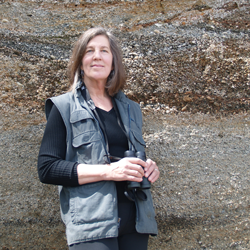 Maria Mudd Ruth is the author of more than a dozen books on natural history topics for general audiences, young readers, and accidental naturalists, including the critically acclaimed Rare Bird: Pursuing the Mystery of the Marbled Murrelet and A Sideways Look at Clouds. Ruth lives in Olympia, Washington. She has been a community scientist and guillemot groupie since 2013. You can learn more about her work on her website.
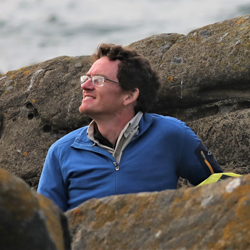 Eric Wagner is a staff writer with the Puget Sound Institute at University of Washington, Tacoma. He is author of After the Blast: The Ecological Recovery of Mount St. Helens, Penguins in the Desert, and Once and Future River: Reclaiming the Duwamish. His essays and journalism have appeared in Orion, Audubon, High Country News, Smithsonian, and The Atlantic, among other publications.
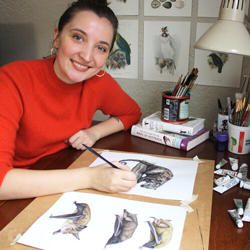 Madison Mayfield is the Assistant Collections Manager of Ornithology at the Burke Museum. She is a natural history artist, taxidermist, educator and museum professional. Madison is passionate about introducing anyone and everyone to the world of science illustration and nature journaling. Her own personal art practice is driven by her work in museum collections and often focuses on birds as specimens.
 Sarah DeWeerdt is a freelance science journalist based in Seattle. She is a 2024 recipient of the National Academies of Science/Eric and Wendy Schmidt Award for Excellence in Science Communication. Her work covering biology, medicine, and the environment has appeared in publications including Anthropocene, Atmos, bioGraphic, Nature, and Nautilus.
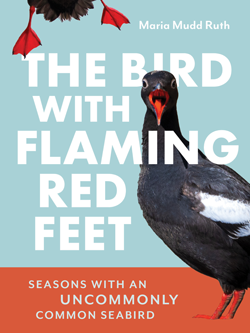 The Bird with Flaming Red Feet is a lively and heartfelt natural history of the Pigeon Guillemot, a charismatic seabird with a surprising story to tell. Found along the coast around the North Pacific and from Alaska to Southern California, this talkative and often-overlooked bird plays an outsized role in the health of marine ecosystems, earning its status as an “indicator species.” Author and longtime volunteer surveyor Maria Mudd Ruth weaves together science, field observation, and community storytelling to paint a vivid portrait of this special species and the ecosystems, both natural and human, surrounding it. Drawing from over a decade of beachside study, Ruth dives deep into the guillemot’s behaviors, quirky traits, and ecological relationships. Along the way, readers meet the passionate citizen scientists who have built a unique community around caring for and studying this vibrant bird. Bridging the gap between field guide and memoir, The Bird with Flaming Red Feet invites readers to slow down, look closely, and reconnect with the wild places — and creatures — just outside their door. It’s a joyful call to observation, stewardship, and a deeper understanding of the natural world and our place in it.
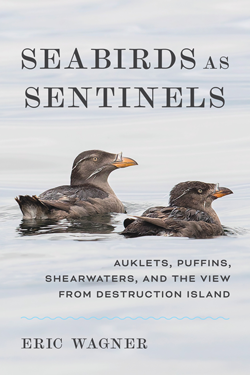 Every spring, thousands of rhinoceros auklets return to Destruction Island off Washington’s coast, where they dig burrows, lay eggs, and raise their chicks. Small, gray, and adorned with a curious horn on their bill, these funny-looking birds have become an unlikely but vitally important indicator for the health of oceans and the Pacific ecosystem as a whole. In Seabirds as Sentinels, Eric Wagner joins a team of scientists who have been tracking the lives of auklets and other seabirds to gauge the effects of climate change in the region. The North Pacific — sometimes called the Blue Serengeti — is one of the most productive ecosystems on Earth, supporting salmon, whales, seals, and countless other species, including people. Yet its waters are changing in unprecedented ways. Mass die-offs of birds, hordes of jellyfish blanketing beaches, and the sudden appearance of tropical species all point to an ocean in flux. Wagner intersperses accounts of research expeditions with deep dives into phytoplankton, forage fish, lighthouses, ocean currents, and other important elements in the Pacific Ocean’s tangled ecological web. Readers travel into auklet burrows by fiber-optic camera and witness the eerie arrival of seabirds under cover of night, seeing firsthand how these birds have tried to adapt to widespread environmental upheaval. Weaving together natural history, marine science, and the myriad stories that humans tell about their environments, Seabirds as Sentinels helps us keep a close watch on the uncertain future of the oceans that sustain us all.
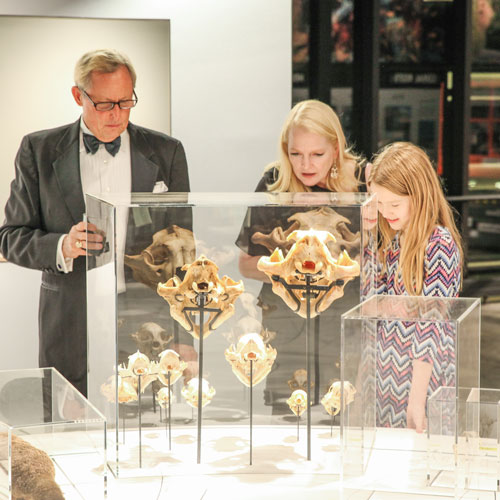
Host your one-of-a-kind gathering at the Burke Museum and give your guests an experience they'll never forget.
Continue to general admission tickets page.