
When I first encountered teeweewas Tillie Jones’s t̓uʔal̕š ad (tumpline) at the Burke Museum, I noticed how quietly it occupied its space. Suspended from a display stand, the tumpline has the kind of visual appeal that, at first glance, encourages quick passing. Yet the closer I looked, the more it revealed a depth of meaning layered into its materials and its construction. The longer I spent looking at it, the clearer it became that this work is not just an example of Coast Salish weaving or a functional object. Rather, it is a woven expression of care; care for the land, for animals, for ancestors, for community, and for the cultural knowledge that sustains all of these relationships. Carefully prepared soft mountain goat wool and the firm, plant-based nettle cord, carry histories of tending, gathering, breeding, spinning, and weaving. In the hands of Jones, these materials are activated again, not as a nostalgic performance of tradition but as living practices that continue to shape Salish identity today.
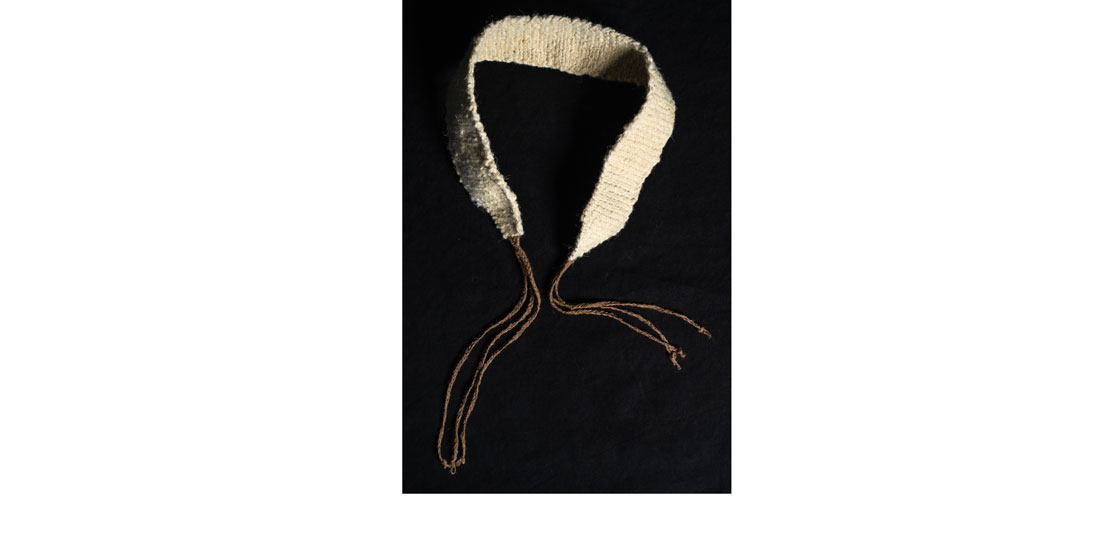
The tumpline’s form is deceitfully simple, a curved strap of densely woven white wool with two long cords of stinging nettle hanging from each end. The arch of the woolen band suggests the shape of a human forehead, showing the traditional way tumplines were worn by Salish women who used them to carry baskets, bundles of harvested foods, firewood, or other heavy loads. This relational shape, the curved band speaking to the curved body, signals immediately that the object is not meant to be understood as sculpture alone, but also as a tool animated by motion and labor. The contrast between the softness of the wool and the slightly rougher, earth toned nettle fibers emphasizes the dual roles the object played, comfort where the strap rested on the skin, and strength where the load was supported. The careful transitions between materials show Jones’s attention not just to appearance but to the physical realities of those who historically relied on tumplines in everyday life.
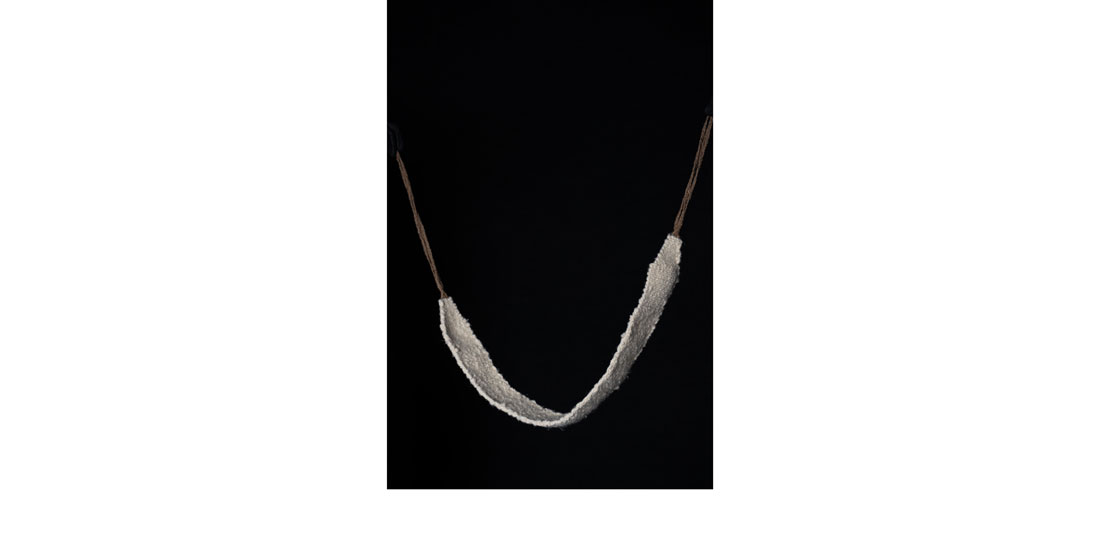
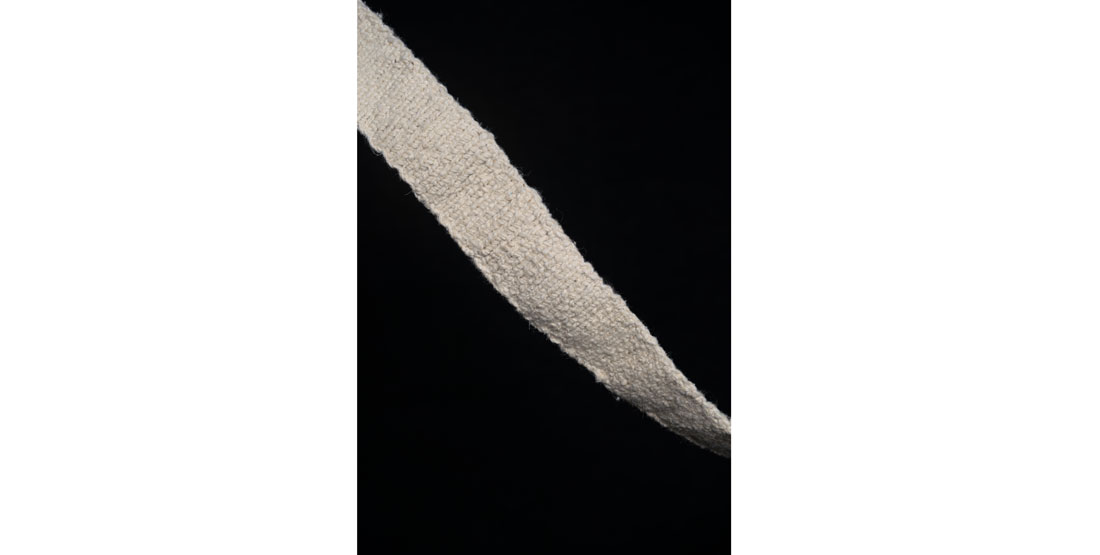
Gathering mountain goat wool historically required deep knowledge of the land, knowing where the goats traveled, when their coats shed naturally, and how to harvest the fibers ethically. This was an approach rooted in respect and sustainability rather than extraction. When I realized this, the tumpline’s softness took on a new significance. It is a material that carries the ethical frameworks, ecological knowledge, and rhythms of life important to Coast Salish culture. Chickasaw curator heather ahtone describes this as “kincentricity,” a philosophy recognizing humans as part of a network of relationships with animals, plants, and natural forces. Jones’ use mountain goat wool — still difficult to gather, still requiring knowledge of land and animal behavior—she is participating in a lineage of women who cultivated fiber sources through relational practices.
The tumpline’s identity as a tool cannot and should not be stripped away. Its form tells a story of women’s labor, endurance, and contribution to communal life. Jones’s tumpline participates in this, and reflects the care that underlies the labor of weaving itself. To produce mountain goat wool suitable for weaving, a fiber artist must wash, card, spin, and sometimes combine fibers, each step requiring attention and patience. The same is true for preparing nettle fibers. Therefore, the tumpline becomes a physical accumulation of time spent in careful, tangible work.
The tumpline does not simply represent care; it is care, materialized. And the weaving itself expresses care for cultural continuity, for elders who preserved these techniques, and for the next generation who will inherit them. In this sense, the tumpline is a condensed and portable archive of relational ethics. The materials are the primary conveyors of meaning.
Looking at the tumpline also reshaped how I understand the concept of “function” in Indigenous art. Western museum practices often frame utilitarian objects as lesser, as if functional pieces do not operate on the level of meaning or aesthetic intention. But Coast Salish tumplines challenge that assumption. Their form is inherently aesthetic; regular geometric tension, rhythmic spacing, and an interaction between fiber types. Their functionality does not diminish their artistry, it enhances it. When used in daily life, it rested across the forehead, distributing weight across the body with a kind of structural grace. That embodiment of balance, between body and burden, comfort and strength, is mirrored in the visual balance of the object itself.
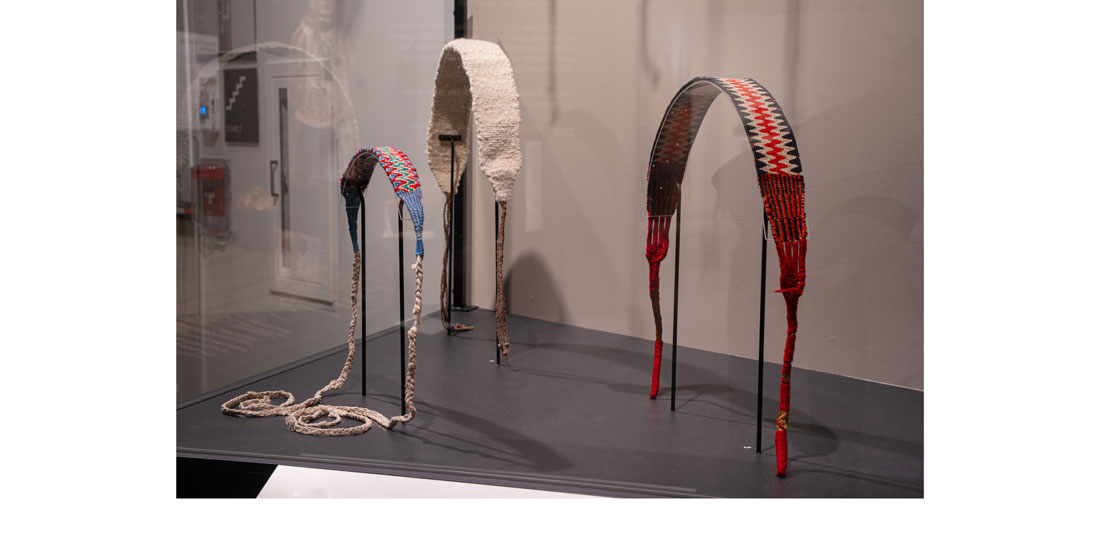
The museum environment, however, changes the relationship between viewer and object. The tumpline is now suspended in stillness, not touching human skin or bearing weight. This stillness emphasizes its sculptural qualities but also reveals the absence of the women whose labor once gave life to such tools. In this absence we can sense the history of colonial disruption that almost extinguished Salish weaving practices. Jones’s decision to create a contemporary tumpline is not simply artistic, it is political and restorative. It asserts the survival of Salish cultural knowledge despite historical attempts to extinguish it.
Jonathan Day is an undergraduate art major who wrote this blog for Art History 435, a class on women artists of the Northwest Coast. The class was offered by Katie Bunn-Marcuse, the Burke's curator for Woven in Wool and associate professor of art history.