


Introduction |
 In the current
renewal of interest in global biodiversity, the complex and threatened
floras and faunas of tropical regions of the world have received
considerable attention. In contrast, certain temperate and boreal biotas
have been ignored, despite high biotic diversity, the absence of basic
taxonomic information, and the threat of plant and animal extinctions. Of
all such northern regions, the islands of the Kuril Archipelago probably
stand out most as being "biologically unknown" and, at the same time, in
danger of over exploitation. A chain of more than 56 islands, the system
is only slightly smaller than the Hawaiian Islands, covering an area of
15,600 square km and providing 2,409 km of coastline. Stretching 1,200 km
between Hokkaido, the northernmost island of Japan, and the Russian
peninsula of Kamchatka (from 43 to 51 degrees N latitude), the Kurils
divide the Sea of Okhotsk from the Pacific Ocean and form the northern
extension of an insular arc that originates in the Ryukyu and Mariana
archipelagos to the south and continues as the Aleutian Islands to the
north and east. All of the Kurils are volcanic in origin, ranging in age from
Upper Cretaceous to Late Pleistocene; each island has its own unique
geological and biological history. Substantial opportunities for in
situ diversification are provided by great distances between the
islands and mainland source biotas and by significant barriers to plant and
animal dispersal (e.g., deep channels between islands, associated with
strong ocean currents). In the current
renewal of interest in global biodiversity, the complex and threatened
floras and faunas of tropical regions of the world have received
considerable attention. In contrast, certain temperate and boreal biotas
have been ignored, despite high biotic diversity, the absence of basic
taxonomic information, and the threat of plant and animal extinctions. Of
all such northern regions, the islands of the Kuril Archipelago probably
stand out most as being "biologically unknown" and, at the same time, in
danger of over exploitation. A chain of more than 56 islands, the system
is only slightly smaller than the Hawaiian Islands, covering an area of
15,600 square km and providing 2,409 km of coastline. Stretching 1,200 km
between Hokkaido, the northernmost island of Japan, and the Russian
peninsula of Kamchatka (from 43 to 51 degrees N latitude), the Kurils
divide the Sea of Okhotsk from the Pacific Ocean and form the northern
extension of an insular arc that originates in the Ryukyu and Mariana
archipelagos to the south and continues as the Aleutian Islands to the
north and east. All of the Kurils are volcanic in origin, ranging in age from
Upper Cretaceous to Late Pleistocene; each island has its own unique
geological and biological history. Substantial opportunities for in
situ diversification are provided by great distances between the
islands and mainland source biotas and by significant barriers to plant and
animal dispersal (e.g., deep channels between islands, associated with
strong ocean currents).
|
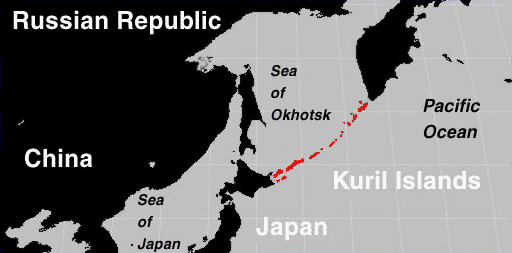 Location of the Kuril Archipelago (red) in the Western North Pacific Ocean.
|
|
The geographic
remoteness and inaccessibility of the Kurils (Russian publications refer
to the islands as "the end of the world"; e.g., Pushkar, 1960: 172;
Shurtakov, 1962: 12, 1971: 114), combined with extreme environmental
conditions, have discouraged human visitation. Storms, volcanic
eruptions, earthquakes, and tidal waves; blistering winter winds
alternating with impenetrable summer fogs; ravenous swarms of mosquitoes
and foul smelling masses of floating seaweed all have contributed to make
the Kuril Archipelago one of the least known corners of the earth
(Stephan, 1974: vii, 11-12).
|
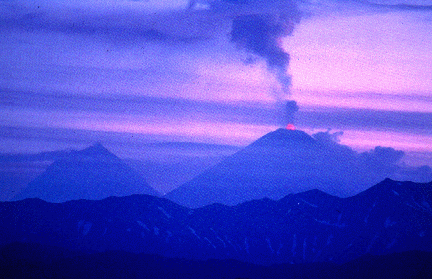 Klyucherskaya Sopka in eruption, Kamchatka Peninsula.
|
|
Climatically, the
various parts of the Kuril Archipelago are highly variable. The
northernmost islands of the arc (e.g., Shumshu and Paramushir) are almost
Arctic, while the southern islands (Kunashir and Iturup) contain pockets
that are nearly subtropical. Consequently the flora of the islands is
variable as well. Extending over eight degrees of latitude, the arc is
divided into distinct botanical zones (Stephan, 1974: 17). Tundra
dominates in the northern zone (Shumshu to Shiashkotan), with only a
scattering of stunted pines, birches, and assorted scrub. The central
zone (Lovushki to Simushir) has the poorest vegetation, some of the
smaller members consisting of little more than rocky protuberances that
support only lichens, mosses, and a few species of bushes. The southern
zone (Urup to Kunashir and the Habomais) possesses a relatively rich
flora due to warm ocean currents and abundant rainfall; in addition to
coniferous and mixed forests of birch and spruce, there are linden, ash,
oak, and maple trees in protected pockets.
|
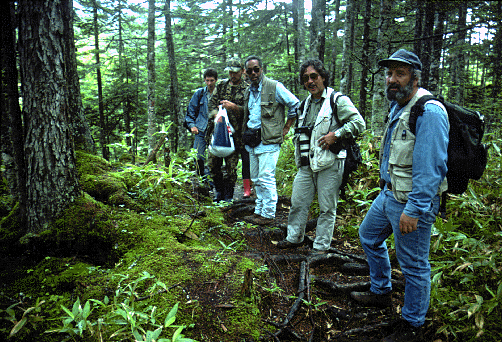 IKIP 1995 expedition party in forest on Kunashir, with Michael S. Yamashita, photographer, and Charles E. Cobb, writer, on assignment with the National Geographic Society.
|
|
Very little published
information can be found on the fauna of the Kurils; general statements
about the larger mammals, marine birds, and commercially important fishes
(salmon and cod) and crustaceans (king crab) are the only exceptions.
Brown bears, wolves, squirrels, and snowshoed hares inhabit the larger
islands. Tens of thousands of sea otters, fur seals, and sea lions once
populated the chain, but today only small colonies exist on the central
islands. The literature records more than 170 species of birds (but some
unpublished estimates are as high as 280; see "Rationale and
Scope--Birds"). Island rivers
seasonally overflow with salmon, and offshore waters support abundant
populations of cod, mackerel, and ocean perch. King crab from Kunashir
and Iturup are still harvested in large quantities.
|