


Rationale and Scope |
| Inventory of existing collections.--Museum collections of
Kuril plants and animals are almost nonexistent outside the Russian Republic.
A survey of collections throughout Japan turned up some higher plants
maintained in the Faculty of Agriculture, Hokkaido University, and less
than a dozen fishes in the Faculty of Fisheries, Hokkaido University;
other than this, and a portion of the material collected by us in 1994,
virtually nothing exists in Japan: material collected prior to World
War II, as well as that resulting from a 1942 expedition to the
northern Kuril Islands by the Zoological Department of Research,
Institute for Natural Resources (see Kuronuma, 1943), was destroyed by
fire in 1945 (Amaoka, pers. comm., 20 August 1993). Since the close of
the War, nothing has come to Japanese institutions.
|
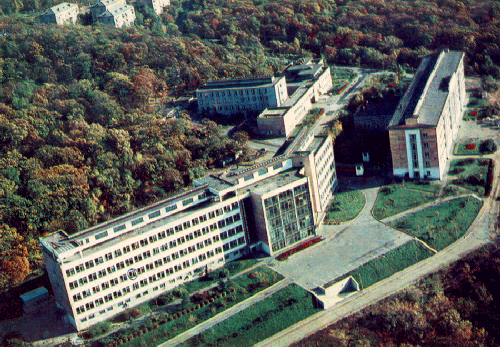 Institute of Biology and Soil Sciences, Russian Academy of Sciences, Far East Branch, Vladivostok.
|
 Collections of various
plant and animal taxa do exist, however, in the various institutes of the
Russian Academy of Sciences, primarily at Vladivostok, Magadan, St.
Petersburg, Moscow, Novosibirsk, and Yuzhno-Sakhalinsk (in preparing this
proposal, detailed estimates of the numbers of lots of Kuril plants and
animals in Russian institutions were compiled, but space restrictions
prevent inclusion of this material here). Smaller collections exist at
Perm, Alma-Ata, and Bishkek, and many private collections are maintained
by Russian scientists as well. As part of this request, we propose to
produce computerized inventories of all Kuril Island material found in
these collections. Collections of various
plant and animal taxa do exist, however, in the various institutes of the
Russian Academy of Sciences, primarily at Vladivostok, Magadan, St.
Petersburg, Moscow, Novosibirsk, and Yuzhno-Sakhalinsk (in preparing this
proposal, detailed estimates of the numbers of lots of Kuril plants and
animals in Russian institutions were compiled, but space restrictions
prevent inclusion of this material here). Smaller collections exist at
Perm, Alma-Ata, and Bishkek, and many private collections are maintained
by Russian scientists as well. As part of this request, we propose to
produce computerized inventories of all Kuril Island material found in
these collections.
Study sites.--In this request, we propose to survey the 17 major islands of the Kuril Archipelago (defined as all those with freshwater, streams as well as lakes, with areas greater than 50 square kilometers): in the southern group these include (5 islands) Kunashir, Iturup, Urup, Shikotan, and the largest of the Habomai group, Zelionyi; in the central group (4), Simushir, Ketoi, Rasshua, and Matua; and in the northern group (8), Shiashkotan, Ekarma, Kharimkotan, Onekotan, Makanrushi, Paramushir, Shumshu, and Alaid (in preparing this proposal, detailed physical descriptions of all the islands of the Archipelago were compiled, including area, elevation, geological age, size and location of mountains, streams, rivers, and lakes, etc., but space limitations prevent inclusion of this material here). We also propose to spend one field season surveying the little known flora and fauna of the southern tip of Kamchatka, an important source biota for the Kuril Islands; the Japanese fauna and flora to the immediate south is well known. Taxonomic breadth.--In this proposal, focus is on freshwater and terrestrial plants and animals, these being (1) much less understood taxonomically than marine organisms (which typically have much broader geographic distributions), (2) far more vulnerable to adverse human impact and exploitation, and (3) more likely to provide the basis for significant future research (e.g., inter-island biogeography). Within this selected assemblage, we propose that vascular plants, insects, spiders, freshwater and terrestrial mollusks, fishes, and terrestrial vertebrates be sampled. Criteria for inclusion of various taxa include (1) those groups likely to display high levels of local endemism among subtaxa, (2) groups especially vulnerable to human impact, and (3) those taxa within the interest and expertise of personnel at the collaborating institutions.
|
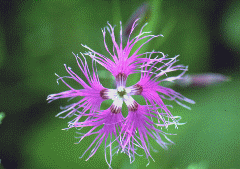
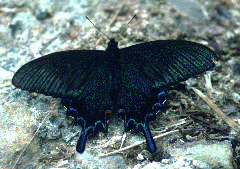 Dianthus superbus, Caryophyllaceae (Kunashir); Papilio sp., Goryachiye Kluychi hotsprings (Kunashir).
|
|
Insects: About
3,000 species of insects are recorded from the
Kuril Archipelago but the true number is probably well in excess of
15,000 (M. K. Glubokovsky, pers. comm., 18 June 1993). An analysis of
the present state of knowledge of aquatic taxa, which are among the least
known insect groups, will serve as an example: ten species of mayflies
(Ephemeroptera) have been recorded from the Kurils, another nine are
listed as "possible" inhabitants (Tshernova et al., 1986; Tiunova, 1991),
but unpublished data (T. M. Tiunova, pers. comm., 23 April 1993) indicate
the presence of perhaps as many as 35 species. Stoneflies (Plecoptera)
are represented on the Kurils by at least 37 species (six of which remain
unidentified to species and are probably undescribed); another four are
listed as possible inhabitants (Zhiltzova and Levanidova, 1984). Two genera
and three species of alderflies (Megaloptera) are known from the Kurils
(Vshivkova, 1989), but these are recorded from only three islands (Kunashir,
Shikotan, and Iturup); no systematic collecting has been attempted on
other islands of the Archipelago (T. S. Vshivkova, pers. comm., 23 April
1993). Twenty-one species of midges (Chironomidae) have been recorded from
the islands and adjacent Sakhalin (Makarchenko, 1985), but E. A.
Makarchenko (pers. comm., 23 April 1993) believes that there are at least
200 in all. Fifty-seven species of caddisflies (Trichoptera) are listed
as inhabitants of the Kurils (Levanidova, 1986, 1989; Vshivkova, 1986),
but T. S. Vshivkova (pers. comm., 23 April 1993) thinks that more than 100
will eventually be found.
|
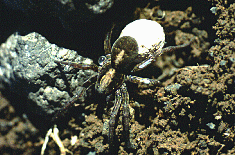
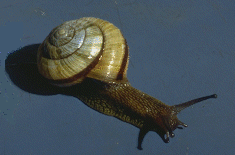 Female Trochosa terricola, Lycosidae, with egg sac (Chirpoi); Bradybaena sp., Bradybaenidae (Iturup).
|
|
Freshwater and
terrestrial mollusks: The molluscan fauna of the
Kurils is practically unknown. Among freshwater species, nine bivalves
(one endemic) and eight gastropods (two endemic) are known; of terrestrial
gastropods, 12 species are known and another seven listed as possible
inhabitants of the islands (Zatravkin and Bogatov, 1987; Bogatov and
Zatravkin, 1990). The actual numbers, however, are much greater: on the
southern Kurils, numerous endemic populations of bivalves are said to be
present and undescribed in the many small isolated lakes that dot nearly
all the islands (e.g., at least 19 lakes on Shumshu, 5 on Onekotan, 7 on
Simushir, 14 on Iturup, 10 on Kunashir, and 8 on the largest of the
Habomai group); and it is estimated that at least 50 species of
terrestrial gastropods remain to be described from the more heavily
vegetated southern islands (Victor V. Bogatov, pers. comm., 26 March 1993).
|
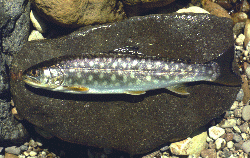
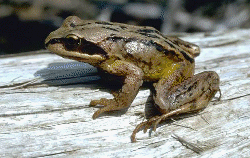 Salvelinus leucomaenis, Salmonidae (Kunashir); Rana chensinensis, Ranidae (Kunashir).
|
|
Amphibians and
reptiles: Seven species of amphibians and reptiles
are recorded from the Kurils: one salamander, two frogs, one skink, and
three snakes (L. J. Borkin, pers. comm., 15 June 1993). All have been
collected from only a single island (Kunashir) except for one of the
frogs (Rana chensinensis David), which is also known to occur on
Shikotan and on Zelionyi and Tanfileva (small islets of the Habomai
group). None of the other islands have ever been sampled
herpetologically. There is some indication that these species associate
with hot springs and lakes (V. A. Kostenko, pers. comm., 18 June 1993;
pers. obs., July-August 1994).
|
|
Birds: The
number of birds that inhabit the Kurils is unknown.
Estimates range from 153 (V. A. Nechaev, 1969, pers. comm., 14 May 1993)
to as high as 280 on the southern islands alone (Kunashir, Iturup,
Shikotan, and the Habomais). Our efforts will be directed toward
building a definitive list of species, but also toward discovering
critical habitats used as molting or migratory staging areas. A primary
focus will be the collection of tissues to be used for general molecular
systematic studies, to help identify breeding sources of origin for
migrants, and to analyze inter-island variation in species that are
permanent residents or known to be local breeders.
|
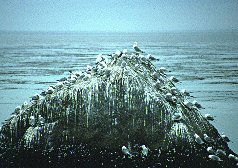
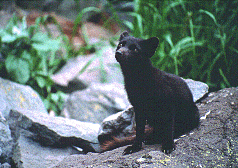 Rissa tridactyla, Laridae (Ketoi); Alopex lagopus, Canidae (Ushishir).
|
|
Terrestrial
mammals: Thirty-one species of mammals have
been recorded from the Kurils: six insectivores, six chiropterans, nine
carnivores, nine rodents, and one lagomorph (Krivosheyev, 1984, per.
comm., 22 April 1993). At least four undescribed species of rodents have
been identified; bats have never been studied and the number of recorded
species is undoubtedly significantly higher (V. A. Kostenko, per. comm.,
18 June 1993).
Cooperating organizations and agencies.--The work will be shared almost exclusively by personnel from three organizations: (1) the University of Washington Burke Museum, Seattle; (2) institutes of the Far East Branch of the Russian Academy of Sciences at Vladivostok (primarily the Institute of Biology and Soil Sciences and Institute of Marine Biology); and (3) various departments of Hokkaido University, Japan.
Project participants and responsibilities.--The project will be directed and administered by the principal investigator, Theodore W. Pietsch, through the University of Washington Burke Museum, Seattle; Pietsch will take overall responsibility for pre-expedition planning, overseeing all aspects of the field work, supervising post-expedition curation and dissemination of specimens, and coordinating the production of reports and publications. The responsible individual in Russia will be Viktor Bogatov, Deputy Chief Academic Secretary and Chief of Scientific Investigations, Russian Academy of Sciences Far East Branch, Vladivostok. The responsible individual in Japan will be Kunio Amaoka, Faculty of Fisheries, Hokkaido University, Hakodate, Japan. Each of these three primary participants will direct and be responsible for the work carried out by personnel of his respective country.
|
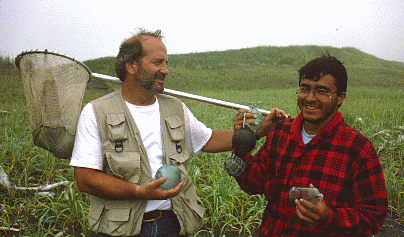 Prof. Theodore W. Pietsch and graduate student Andres Lopez (both UW).
|
| Training.--A high percentage of the personnel associated with the field aspect of the project will be graduate students involved in various research projects in each of the eight major taxa under consideration. All will be given the opportunity to interact with, and receive training from, experts from all three participating nations. Each will take a full and active role in all major aspects of the work: collecting, identification, curation, and data collection and analysis. They will also share authorship and be full participants in the preparation of reports and publications. The provision to provide support for Russian and Japanese students to visit and work with collections at the Burke Museum, University of Washington, will be a further benefit to those whose future mandate will more directly lie with the long-term conservation and preservation of the Kuril Island biotas. It is further envisioned (with financial assistance other than that requested here) that post-doctoral positions might be offered to particularly well-qualified Russian and Japanese students to allow for more long-term study at the University of Washington. |
| Urgency.--While most of the islands now support nearly virgin assemblages of plants and animals, the current political situation poses a serious environmental threat, especially to the southern Kuril Islands, whose rightful ownership is the focus of long-standing debate between Russia and Japan, and whose biota is considerably more diverse than the central and northern members of the chain. Russian policy at present is to populate and otherwise exploit the islands as quickly and as extensively as possible to make a transfer of title to Japan more difficult. In fact, Russian President Boris Yeltsin, hoping to stimulate the economy and attract foreign investments, has recently declared the Kurils a "Free Economic Zone," providing tax advantages to businesses, and offering land at reduced rates and 99-year leases; priority has been given to exploitation of "biological resources" (e.g., deforestation; M. K. Glubokovsky, pers. comm., 26 July 1993). The Japanese, on the other hand, have developed elaborate contingency plans to occupy the islands if and when ownership is achieved. Potential environmental pressures are and will be considerably greater on the more diverse, more productive, and climatically milder southern Kurils. Thus, it is imperative that we act now to explore, document, and protect the unique and delicate floras and faunas of these islands before they are lost forever. |